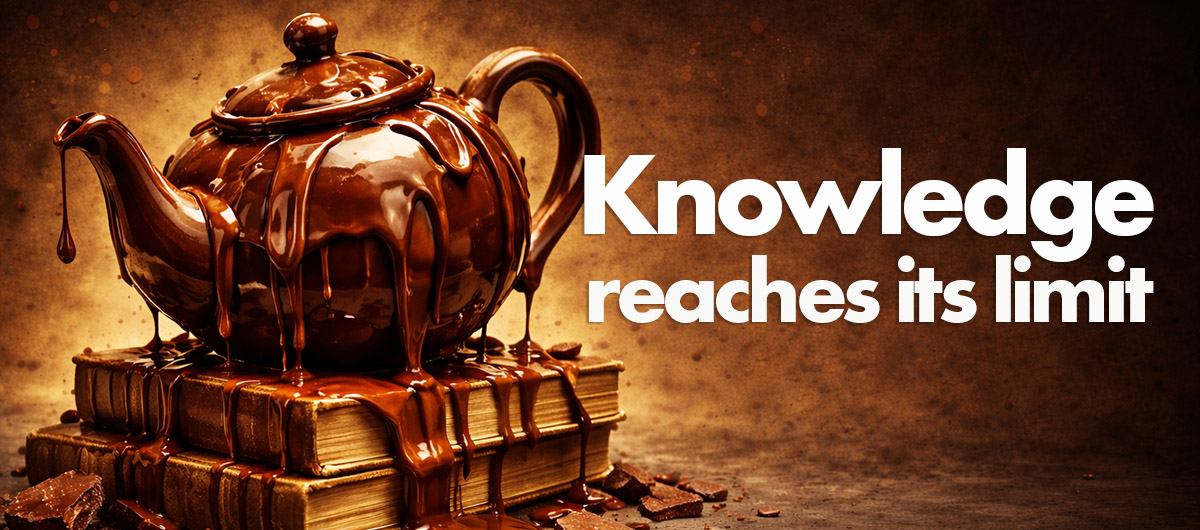
You’re reading part of The Collapse of Knowledge, a long-form series about what happens when certainty stops working.
Each chapter stands alone, but together they trace how trust in expertise fractures, why confident nonsense thrives, and what remains when you stop needing to be right. You can read this piece in isolation, or explore the full sequence from the beginning.
Read the full series: leehopkinswriter.com/collapse-of-knowledge/
There comes a point where knowing more does not make you safer.
It makes you heavier.
For most of my life, knowledge had functioned as protection. If I understood enough, researched enough, triangulated enough sources, I could stay ahead of risk. Knowing was how I stayed oriented.
Until it wasn’t.
I began to notice that the more I understood, the less settled I felt. Each new layer of explanation revealed additional uncertainty rather than resolving it. Answers multiplied questions. Clarity dissolved into complexity.
This was not ignorance.
It was saturation.
I was no longer lacking information. I was drowning in it.
Western culture treats confusion as a signal that more data is required. More research. Better experts. Longer explanations. We assume that clarity is a volume problem.
Sometimes it isn’t.
Sometimes knowledge simply reaches the edge of what it can do.
For people whose identities are built around understanding, this is profoundly destabilising. When knowing stops helping, it feels like personal failure rather than structural reality.
I tried to push through it.
I read more. Followed smarter voices. Refined my filters. All of it sharpened the edges and hollowed out the centre.
The problem was not that the information was wrong. It was that information alone could no longer perform the emotional labour I was asking of it.
I had been using knowledge to regulate anxiety. To create the illusion of control. To convince my nervous system that if I understood enough, nothing truly bad could surprise me.
Life does not work that way.
At some point, knowledge becomes descriptive rather than protective. It tells you what is happening without telling you how to live inside it. It maps the terrain but offers no shelter.
Vietnam made this obvious in ordinary ways.
You can understand why a road is blocked and still be late. You can analyse the weather patterns and still get soaked. You can grasp the system perfectly and still have to endure it.
Explanation does not cancel experience.
Once I stopped demanding that knowing make me safe, something eased. Not because the world became clearer, but because I stopped asking clarity to do work it was never designed to do.
There is a quiet maturity in recognising when understanding has done all it can.
After that point, what matters is not what you know, but how you move.
The Collapse of Knowledge – Series Index
- My upbringing in certainty
- The seduction of being right
- The first cracks
- Leaving the West without leaving Western thinking
- When uncertainty becomes livable
- The collapse of trust
- When knowing stops helping
- The exhaustion of vigilance
- Learning to trust differently
- The hunger for authority
- YouTube University
- Identity after certainty
- Performance replaces understanding
- The comfort of camps
- The quiet seduction of certainty
- What survives the collapse
- Living without needing to be right